



The advance of the BRICS alliance will not be enough to dislodge the US dollar (USD) from its role as the world’s reserve currency, according to BNY Mellon.
Experts say that the technological aspect will maintain the dollar’s presence in the global economy and that it is unlikely to lose its current dominant status.
Meanwhile, the euro is losing ground in global trade and the Chinese renmimbi is gaining popularity in financial markets.
See below for full details.
The dollar (USD) will manage to retain its global reserve status even in the face of the BRICS threat, according to BNY Mellon.
Well-known New York bank BNY Mellon, which manages $1.8 trillion in AUM, recently reassured the US public by stating that the strong expansion of the BRICS bloc will not be enough to dethrone the dollar (USD) from its role as the world’s reserve currency.
In a note published on Friday, the banking institution expressed its bewilderment at imagining a future scenario in which the US dollar is replaced by a new common currency within the alliance of Brazil, Russia, India, China and South Africa.
In particular, Bob Savage, head of market strategy at BNY Mellon, believes that the technology factor, in which the US is dominant, will guarantee the continued hegemony of the USD currency.
His words:
“We believe that the most important factor for the use of the USD over the next decade will be technology, particularly high-end computer chips. The USD is unlikely to lose its global reserve status any time soon… New monetary unions should focus on technology or green baskets, rather than gold or carbon-based ones.”
Meanwhile, two weeks ago the BRICS leaders invited six new countries to join their reserved group: Argentina, Egypt, Ethiopia, Iran, Saudi Arabia and the United Arab Emirates, further strengthening the anti-American bloc and putting pressure on the dollar (USD).
At a recent meeting, the union recalled the importance of using local currencies in international trade and financial exchanges to accelerate the de-dollarisation process.
The new international federation also sees the weight of exports of commodities such as gold and oil growing and taking a large share of the market.
Meanwhile, there is a risk of conflict with the global narrative of the transition from fossil fuels to renewable energy sources.
Commenting on the birth of BRICS, Robert F. Kennedy, US presidential candidate and bitcoin supporter, explained that no country wanted to be part of the alliance, but the militarisation of the dollar and expansive policies abroad left the East with no choice.
Within this conflict in the context of the global currency landscape, Ripple’s CTO went so far as to state that cryptos such as XRP could play a key role in this context and challenge the dollar (USD) as the world’s reserve currency.
As the BRICS alliance expands, the euro loses ground in global trade and the Chinese renminbi rises in financial markets
While banking institution BNY Mellon and its analysts support the strength of the US dollar (USD) in the fight against the advance of the BRICS, it is interesting to note how other currencies such as the euro and the Chinese renminbi are behaving.
Although much of the debate here focuses on the concept of de-dollarisation, few notice how the euro has lost ground in the global trade market over the past two years.
While the EU currency has maintained a good exchange rate against other foreign currencies, its use in trade outside the eurozone has fallen sharply, with negative rates of more than 25%.
At the same time, the Chinese renminbi (CNY) is becoming increasingly popular as an international payment currency, growing by around 0.85% in this context as part of the BRICS’ shrewd aim to promote the use of the alliance’s local currencies.
The following data is taken from the SWIFT RMB Tracker in a paper published on 23 August analysing the progress of the Chinese renminbi in recent years.
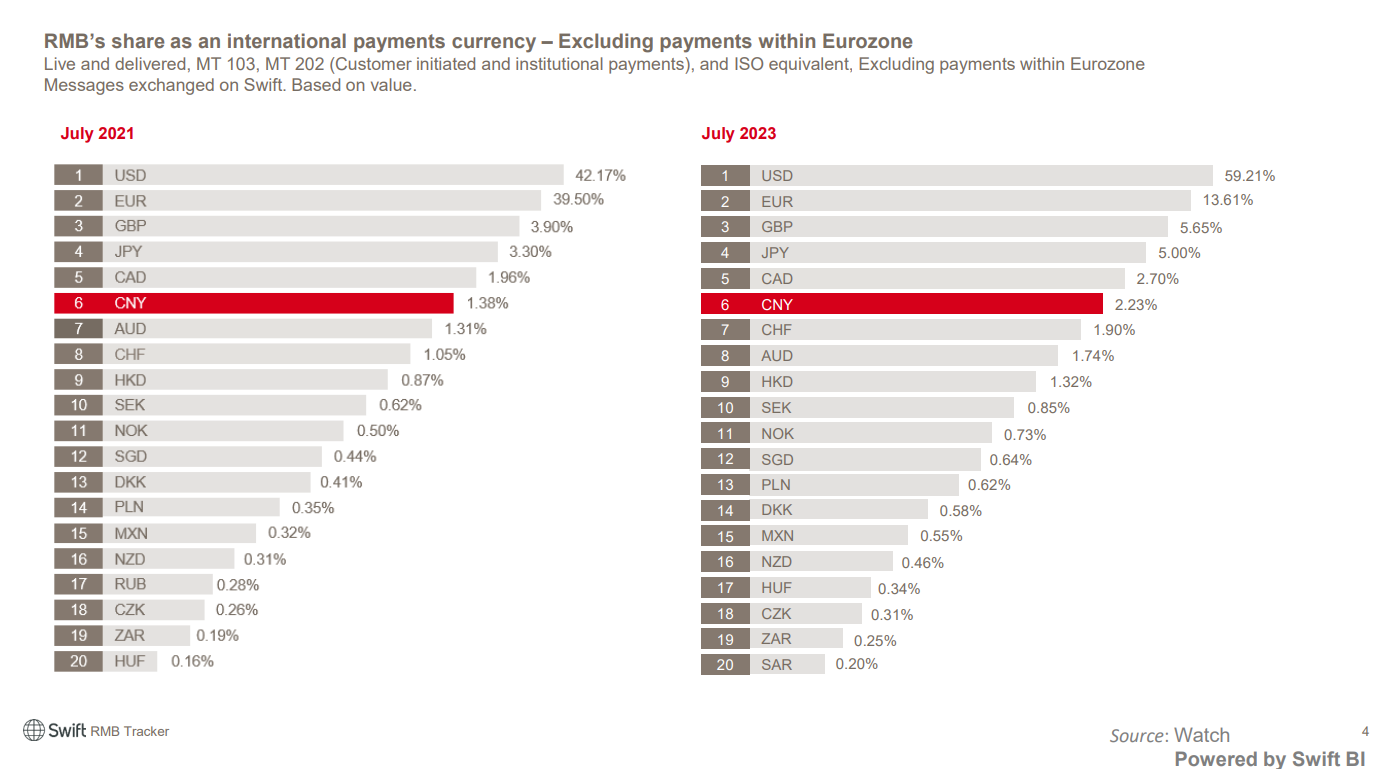
The development of the CNY against the USD and the euro is even more visible when we look at the market shares of the use of local currencies in the financial markets.
Compared with July 2021, the dollar fell from 87.76% to 83.94%, while the euro rose from 6.47% to 6.23%.
On the other hand, the CNY performed positively, rising from 1.73% to 4.57%.
Despite the reassurances from BNY Mellon, which we would remind you is biased in this delicate confrontation, it is clear that there is a structural problem for the US dollar underneath.
The US debt ceiling crisis, out of control inflation and the rise of a very strong competitor seem to be some of the main issues facing the nation that has led the world economy for the last decade.
Perhaps the tech powerhouse with Nvidia, Amazon, Microsoft and Google will not be enough to maintain global hegemony in the currency context.
