


When Jack Mallers publicly announced he was stepping down from Twenty One Capital, he framed it simply: “My Bitcoin company is Strike. The work continues.” But the departure on July 20, 2026 was anything but simple. It landed alongside the collapse of a sweeping three-way merger that Tether had spent months engineering — and sent XXI shares into a sharp decline that underlined just how much the market had priced in the ambition of that deal.
Key takeaways
- Jack Mallers stepped down as CEO of Twenty One Capital on July 20, 2026, to focus full-time on bitcoin payments company Strike.
- Raphael Zagury was appointed as the new CEO of Twenty One Capital, effective the same date.
- Strike has exited the proposed three-way merger initiated by Tether in April 2026; only a potential two-way combination between Twenty One Capital and Elektron Energy remains under evaluation.
- Tether is Twenty One’s majority shareholder, having bought out SoftBank’s remaining stake in May 2026.
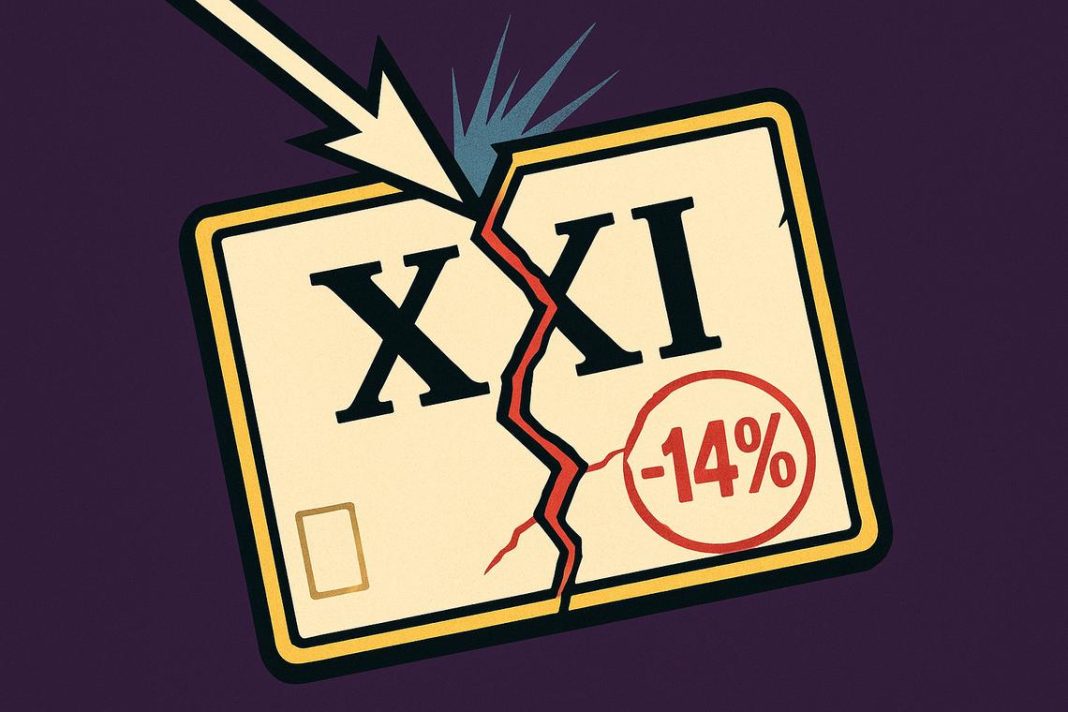
- XXI shares fell over 14% to $4.54 following the announcement, according to The Block.
Leadership Change at Twenty One Capital
The Twenty One Capital leadership change marks the end of a short but pivotal chapter. Mallers helped conceive and launch the company, guided it through a SPAC merger with Cantor Equity Partners, and oversaw its NYSE listing in December 2025 under the ticker XXI. In doing so, he positioned Twenty One as one of the largest corporate Bitcoin holders on public markets.
Jack Mallers Steps Down
Mallers had long been the face of the company, but his heart was always with Strike, the bitcoin payments firm he founded. Stepping away from the CEO seat returns him to full operational focus there. “I’ve decided to step down as CEO of Twenty One,” Mallers wrote on X. “My life’s work remains Bitcoin. My Bitcoin company is Strike. The work continues.”
His exit was framed as an orderly transition, with Mallers and incoming CEO Zagury working together on the handover. Mallers will no longer hold any executive role at the company.
Raphael Zagury Takes Over as CEO
Raphael Zagury brings a profile that is deliberately different from Mallers’ entrepreneur-activist identity. His career runs through Wall Street’s most established institutions — managing director roles at Deutsche Bank and Merrill Lynch, a vice president position at Goldman Sachs, and later co-founding boutique investment bank One Partners and Brazilian fintech lender OpenCo. He holds an MBA from Yale University.
Tether CEO and Twenty One board member Paolo Ardoino made the strategic rationale explicit: “On behalf of the Board of Directors, I would like to thank Jack for his vision and leadership in founding Twenty One Capital.”
That phrasing signals a deliberate pivot in identity. Twenty One is no longer positioning itself purely as a Bitcoin accumulation vehicle. Under Zagury, the mandate is to build an operating company around the balance sheet, not just grow it. Zagury stated: “Twenty One holds one of the largest Bitcoin balance sheets in the public markets. My job is to build the operating company around it, with the discipline, governance, and executional rigor of an institution.”
Restructuring of the Proposed Three-Way Bitcoin Merger
The leadership reshuffle was only one half of Tuesday’s announcement. The other half dismantled a deal structure that had defined Twenty One’s near-term ambitions since April 2026.
Strike Exits Merger Plans
Tether had proposed combining Twenty One Capital, Strike, and bitcoin miner Elektron Energy into a single NYSE-listed entity — a structure that would have brought together Bitcoin treasury management, payments infrastructure, and mining under one roof.
That plan is now off the table, at least in its original form. Strike will remain a standalone business and is no longer being considered for any business combination with Twenty One. The transaction would also have added Strike’s own Bitcoin treasury to Twenty One’s holdings — those plans have been shelved alongside everything else.
The precise reasons for Strike’s exit from the merger have not been detailed publicly, which leaves a meaningful gap in the public record. What is clear is that Mallers’ decision to refocus on Strike as a standalone payments company made his continued involvement in a merged entity structurally incoherent.
Evaluation of Merger with Elektron Energy
The two-way combination between Twenty One Capital and Elektron Energy — the bitcoin mining operation Zagury himself manages — remains under evaluation. But the company’s disclosure was notably cautious: any acquisition of Elektron would constitute a related-person transaction subject to review under Texas law and Twenty One’s internal policies, and the deal sits at a preliminary stage with no assurance it will close.
That caveat carries real weight. With Zagury simultaneously serving as CEO of Twenty One and managing Elektron, the governance complexity is significant. Any deal would require independent board review, and the related-party framing suggests the process will be deliberate rather than swift.
Profile of Elektron Energy and the Strategic Shift
Elektron Energy is described as one of the largest and most efficient bitcoin mining operations in the world. Zagury founded and leads the team that manages it, which is precisely what makes a potential acquisition both strategically appealing and procedurally sensitive.
If the merger does go forward, it would give Twenty One vertical exposure across the Bitcoin ecosystem — from holding Bitcoin on its balance sheet to generating it through mining. That would be a materially different company than the one Mallers built. Zagury has already made clear that his mandate is focused on operating discipline and cash flow generation around Twenty One’s Bitcoin balance sheet.
The revised corporate strategy also includes expanding into capital markets capabilities and bitcoin-backed lending, with further details expected in the coming months, according to the company.
Regulatory and Market Implications
Tether’s Growing Control and the Related-Person Question
The ownership backdrop to all of this is worth examining closely. Tether, which proposed the original three-way merger, is now Twenty One’s majority shareholder after buying out SoftBank’s remaining stake in May 2026. That consolidation of control over a NYSE-listed company with one of the largest Bitcoin treasuries in public markets puts Tether in a uniquely powerful position to set strategic direction — and makes the related-person transaction framing around Elektron even more layered, given Tether’s relationships across the ecosystem.
Any acquisition of Elektron will require a credible independent review process if Twenty One is to maintain the institutional credibility Zagury has been brought in to project.
Market Reaction to the Announcement
XXI shares fell over 14% to $4.54 following the news, according to The Block. The scale of that drop reflects something beyond a simple leadership transition. Markets had been pricing in the optionality embedded in the three-way merger — the idea that Twenty One would absorb Strike’s payments infrastructure and Elektron’s mining capacity, creating a diversified Bitcoin conglomerate. The partial collapse of that thesis, and the uncertainty around whether even the two-way Elektron deal closes, removed a substantial portion of that embedded premium in a single session.
What happens next at Twenty One Capital depends heavily on whether Zagury can make the operational pivot credible — and whether the Elektron merger survives its own governance scrutiny. The company’s Bitcoin balance sheet remains one of the most significant in public markets. Whether that asset base becomes the foundation of a genuinely productive operating business, or stays a treasury story in search of a business model, is the question investors will be watching most closely.
FAQ
Why did Jack Mallers step down as CEO of Twenty One Capital?
Jack Mallers stepped down to focus full-time on Strike, the bitcoin payments company he founded. He stated that Strike remains his life’s work and the place where he intends to continue serving Bitcoin users.
What is the current status of the proposed merger involving Twenty One Capital, Strike, and Elektron Energy?
Strike has exited the proposed three-way merger, leaving only a potential two-way combination between Twenty One Capital and Elektron Energy under evaluation. That deal remains at a preliminary stage with no assurance it will close, and would be subject to review as a related-person transaction under Texas law.
Who is Raphael Zagury and what role does he have at Twenty One Capital?
Raphael Zagury has been appointed CEO of Twenty One Capital effective July 20, 2026. He manages Elektron Energy, one of the largest bitcoin mining operations, and previously held senior roles at Goldman Sachs, Deutsche Bank, and Merrill Lynch. His stated focus is building operational discipline, strong cash flows, and institutional governance around Twenty One’s Bitcoin balance sheet.
How did the market react to the news of the leadership change and merger update?
Twenty One Capital’s XXI shares fell over 14% to $4.54 following the announcement, reflecting market concern over the collapse of the broader three-way merger and uncertainty about the company’s revised strategic direction.
Article produced with the assistance of artificial intelligence and reviewed by the editorial team.