

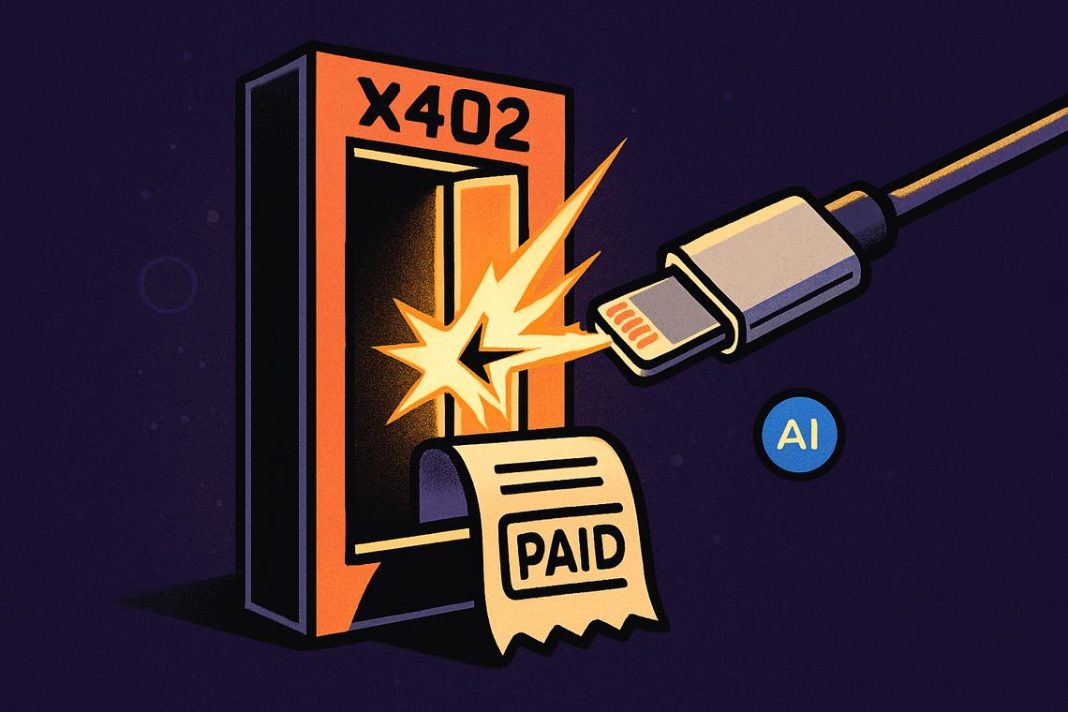

Block, the fintech company led by Jack Dorsey, is rolling out a Bitcoin Lightning integration inside x402, the payment protocol built for AI agents that need to settle bills on their own. The company confirmed this week that it has joined the x402 Foundation and contributed Lightning Network support to the standard, giving artificial intelligence systems a new way to pay for digital services without a human ever typing in a card number.
Key takeaways
- Block has joined the x402 Foundation and added Bitcoin Lightning Network support to the x402 payment standard used by AI agents.
- x402 lets AI agents and web services autonomously pay for API access, data and digital service fees without manual card entry.
- The x402 Foundation launched in April under the Linux Foundation, with Google, Microsoft, Amazon Web Services, Coinbase and the Solana Foundation among its participants.
- Before Block’s contribution, x402 payments ran mainly on fiat currencies and stablecoins.
- Steve Lee, head of Block’s Bitcoin initiative Spiral, called the move “a concrete step toward making Bitcoin everyday money” for people and the agents acting on their behalf.
Block’s Bitcoin Lightning Integration Joins the x402 Foundation
Block’s decision to fold Lightning into x402 answers a simple question: what happens when software, not people, needs to pay for things thousands of times a day? The company says Lightning’s low fees and fast settlement times make it a natural fit for that kind of machine-to-machine commerce.
The x402 Foundation itself is not a small club. It launched in April under the Linux Foundation umbrella, and its roster already includes major cloud and software players like Google, Microsoft and Amazon Web Services, alongside crypto-native names such as Coinbase and the Solana Foundation. Block’s arrival adds a Bitcoin-focused voice to a group that had, until now, leaned heavily on traditional tech infrastructure and dollar-based crypto rails.
Why This Matters for AI Commerce
This matters because it signals that Bitcoin’s payment rails are being positioned early inside the infrastructure that will underpin autonomous AI transactions, rather than being added later as an afterthought. If AI agents end up handling routine purchases on behalf of humans, whichever payment rail is cheapest and fastest at scale stands to capture a meaningful share of that traffic.
How x402 Lets AI Agents Pay for Themselves
x402 works by using the HTTP 402 “Payment Required” response, a mechanism that lets a server request payment mid-interaction when software asks for a paid API call, a dataset or another digital service. Instead of a human stepping in to enter payment details every time an AI agent retrieves information or calls another service, the protocol settles the cost automatically and the agent simply retries its request with proof of payment attached.
That automation is the whole point of the standard. Because x402 lets AI agents and web services handle payments for API access, data, and digital service fees on their own, without any extra manual step, it aligns well with Block’s broader move into AI-driven payments, since eliminating that friction is what makes high-volume, agent-driven commerce feasible in the first place.
From Stablecoins to Bitcoin: x402’s Expanding Payment Rails
Until Block’s contribution, x402’s payment activity ran almost entirely on fiat currencies and stablecoins.
Block’s Bitcoin Lightning integration effectively opens a third lane alongside fiat and stablecoins. Other networks have been expanding x402’s options too, while separate infrastructure work has extended agent payments to other chains as well. The pattern suggests x402 is deliberately designed as a multi-rail standard rather than one tied to a single currency or network.
Why Block Is Betting on Lightning for Agentic Commerce
Block’s rationale centers on speed and cost. The company views Lightning’s low fees and fast processing as well suited to the small-value, high-frequency payments that AI agents are expected to generate as they act on behalf of humans. Steve Lee, head of Spiral, Block’s Bitcoin development initiative, put it directly:
“Bringing Lightning to x402 is a concrete step toward making Bitcoin everyday money for both people and the agents acting on their behalf. We’ll help the industry build more services on top of this.”
The move extends a pattern at Block. The company already operates Square and Cash App, and Dorsey has spent years making Bitcoin a strategic pillar of the business. Block had also previously taken part in the Universal Commerce Protocol, an initiative aimed at helping small businesses run commerce operations using AI. Layering Lightning into x402 fits that same trajectory: it is less a one-off technical contribution and more an attempt to stake out Bitcoin’s place inside the payment infrastructure now forming around AI agents.
Whether that bet pays off depends on adoption that neither Block nor the x402 Foundation has yet quantified in Lightning-specific terms. But the timing is notable — as AI agents move from experimental tools to active participants in commerce, the payment industry is racing to build matching rails, and Block wants Bitcoin’s fastest payment layer in that race from the start.
FAQ
What is the x402 payment protocol?
Under the open payment standard known as x402, AI agents and web services can independently cover costs for API access, data, and digital service fees, bypassing any manual payment procedures.
Why is Block integrating the Bitcoin Lightning Network into x402?
Block views Lightning’s low fees and fast processing speeds as ideal for the small-value, high-frequency payments that AI agents require.
Who operates the x402 Foundation and who are its participants?
The x402 Foundation operates under the Linux Foundation with major participants including Google, Microsoft, Amazon Web Services, Coinbase, and the Solana Foundation.
How does the integration of Lightning Network affect AI commerce?
It supports automated, small-value, high-frequency payments by AI agents, which is expected to be a core aspect of future AI-driven commerce.
Article produced with the assistance of artificial intelligence and reviewed by the editorial team.