

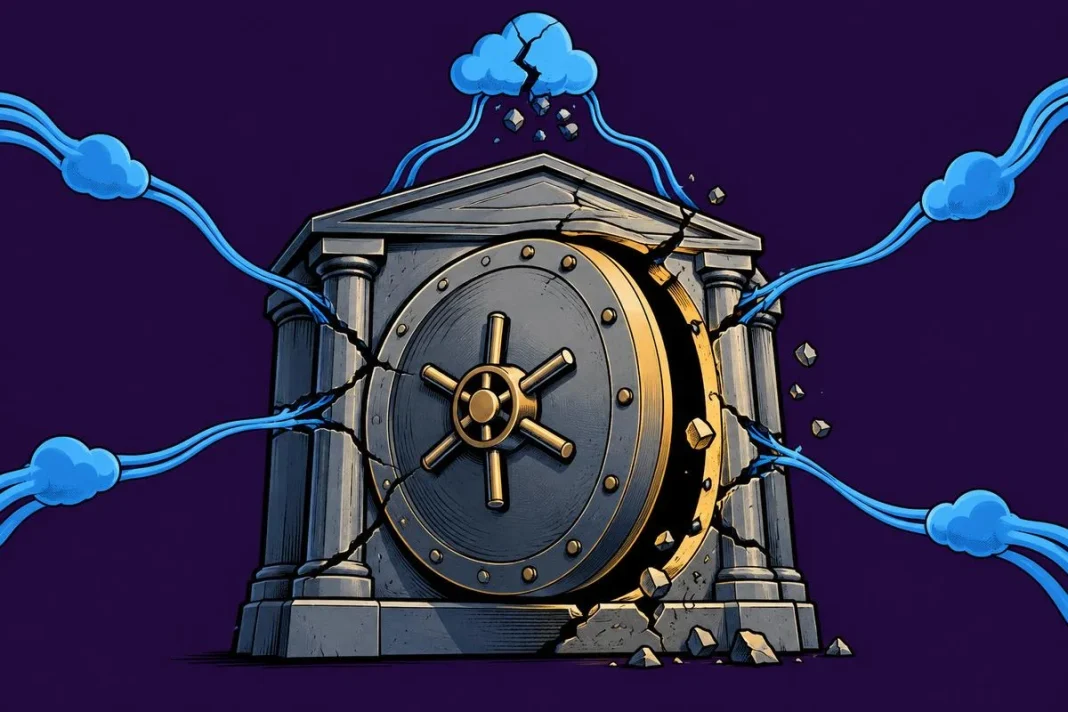

Financial resilience strategies face a challenge beyond financial risk: banks’ growing dependence on cloud and software brings exposure to suppliers, hidden dependencies and supply chain failures. As finance becomes more digital, resilience needs to be built into technology from the outset, rather than added after systems are in place.
Key takeaways
- Third-party dependencies are a central concern for financial resilience.
- Regulatory approaches differ, including on concentration risk.
- Software escrow and stressed exit strategies support supplier-failure planning.
- AI and quantum computing add demands to resilience planning.
Cloud and software dependence puts controls under pressure
Financial institutions’ key controls need to evolve alongside their reliance on technology and increasingly complex supplier relationships. Cloud computing is already a core feature of modern banking, making technology dependencies part of the resilience challenge.
The issue extends beyond the systems institutions use directly. Hidden dependencies, partnerships and supply chains also need to be considered when planning for disruption. Controls must address that complexity as well as changes in the technology itself.
Third-party and supply chain risks expose gaps
Third-party risk and supply chain failure are central threats to operational resilience. Financial institutions often focus on financial risks while overlooking exposures that are not directly tied to monetary losses, even when those exposures can have indirect financial consequences.
Regulators take different approaches to digital supply chains
Regulatory frameworks differ in where they place responsibility for resilience. Some require financial institutions to secure their digital supply chains; others provide guidance directly to suppliers.
The scope of those frameworks also varies. Some jurisdictions do not address concentration risk at all, leaving a distinction between approaches that cover it and those that do not.
Planning for supplier failure
Stressed exit strategies and software escrow are identified as important tools for preparing contingencies in case suppliers fail. They form part of resilience planning that accounts for hidden dependencies and potential supply chain disruption.
The emphasis is on proactive preparation: financial institutions need to consider supplier failure within their resilience strategies, rather than treating third-party exposure solely as a financial risk.
Financial resilience strategies must adapt to emerging technology
AI adoption adds complexity to resilience planning as it becomes more embedded in financial services. The operational demands associated with technology reliance, suppliers and partnerships grow in importance alongside that adoption.
Quantum computing adds a further need for continuous monitoring and adaptation. The challenge described is not simply to establish a resilience strategy, but to adjust it as technology evolves at an accelerating pace.
Engineering resilience from the outset
Resilience needs to be designed into an institution’s technology estate, not treated as an add-on. That approach brings technology controls, supplier dependencies and contingency planning into the same discussion.
A Finextra webinar hosted in association with Escode focuses on these financial resilience strategies. Its stated discussion topics include global regulatory approaches, the requirements for modern resilience and the role of stressed exit strategies in mitigating third-party risk.
Article produced with the assistance of artificial intelligence and reviewed by the editorial team.