



This is the absurd story of a programmer who spent a fortune in Ethereum to warn the crypto community of the impending threat of brain-chip weapons from China.
The user allegedly sent a total of 5 million dollars in ETH to Wikileaks and to a burning address, in an attempt to attract public attention and denounce the criminal activity carried out by a Chinese hedge fund.
The epilogue takes on a dramatic tone, as on-chain messages reveal that the user, in a state of despair, had threatened to take their own life. Let’s discover together the details of this story and the implications behind this extreme act.
The incredible story of a user who sent 500 Ethereum (ETH) to a burning address
Just 9 days ago, while the entire crypto world was in a panic due to the bear price action of Bitcoin and Ethereum, an anonymous user publicly reported a new virtual crime in China. The protagonist of this surreal story is “Hu Lezhi”, the nickname of an individual who presented himself as a regular Chinese web developer. This person allegedly sent a whopping 500 ETH to a burning address, known as “0x0000000000000000000000000000000000000000”, thus losing control over it.
We remind you that burning addresses represent special cryptographic addresses used to “burn” or destroy cryptocurrencies in an irreversible way, as they are not accessible by anyone.
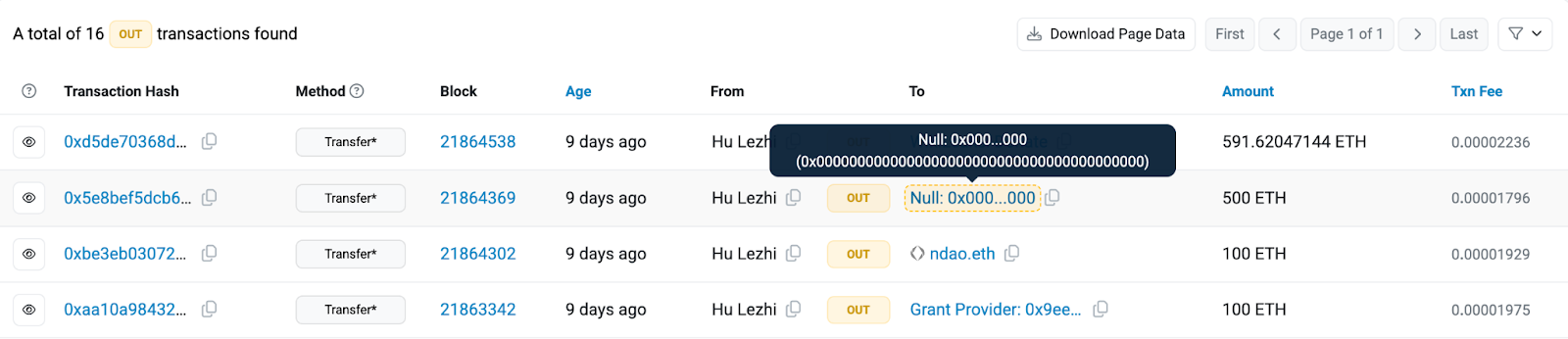
The action was accompanied by a strange on-chain message, in which it almost seems to cry for help regarding alleged mind manipulation activity, carried out by a hedge fund based in China. The message reads as follows:
“The CEOs of Kuande Investment: Feng Xin and Xu Yuzhi have used brain-computer weapons to persecute all employees and former employees of the company, and even they themselves have been controlled“.
According to what was written, the executives of Kuande Investment, later associated with the Chinese quantitative trading company WizardQuant, allegedly abused advanced technologies to manipulate people’s minds. The same hedge fund executives were then reportedly struck by brain weapons themselves, suggesting that they became victims of a mind control system. This scenario has fueled conspiracy theories, portraying advanced technologies as an uncontrollable power capable of influencing even those who initially controlled them.
The most unsettling thing about the incident is that Hu Lezhi, in one of his messages, swore that he would take his own life if he fell victim to this manipulation. The crypto community immediately expressed support for the developer, sending multiple tips to his address. Meanwhile, there were also some degens who didn’t miss the chance to create a memecoin in his name.

Donations to Wikileaks: hidden mysterious messages
The burn of 500 Ethereum tokens is not the only desperate attempt by Hu Lezhi to draw public attention to the alleged psychological manipulations used by China.
The same has indeed sent multiple transactions to different addresses between February 11 and 15, some of which were very substantial to Wikileaks, an organization known for the dissemination of confidential and secret information. In total, he sent to Wikileaks about 711 ETH, equivalent to 1.7 million dollars, in addition to other transfers to the “ndao.eth” wallet and a “Grant Provider“.
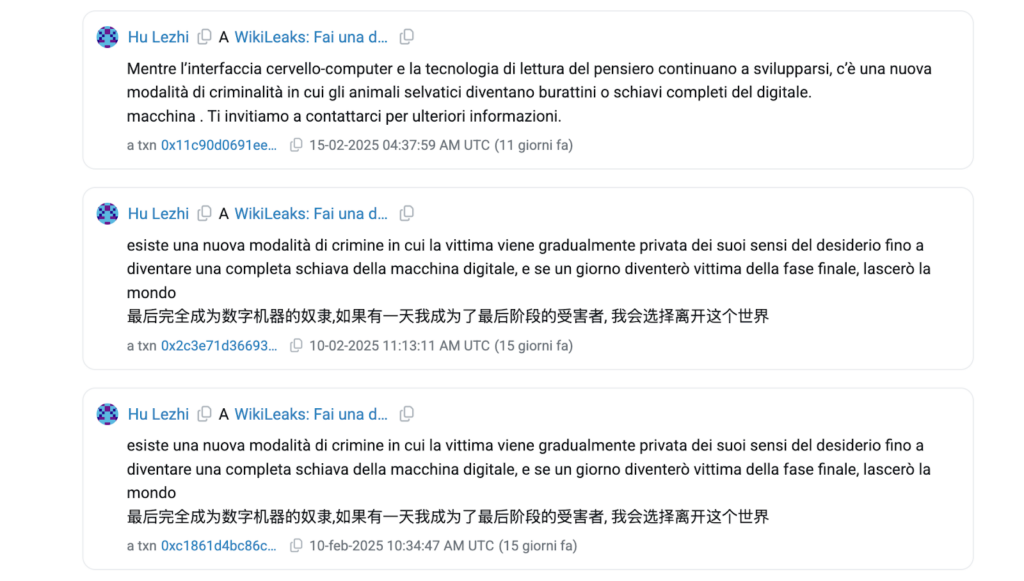
Anchi qui Hu Lezhi, in the transaction to WikiLeaks, has hidden a cryptic message:
“There is a new mode of crime in which the victim is gradually deprived of their senses of desire until they become a complete slave to the digital machine.”
It is evident how the programmer has used the blockchain as a tool of protest to denounce a new form of criminality that exploits technology to control and manipulate people in a subtle and irreversible way.
All these messages, combined with high-value transactions in Ethereum, raise questions about the use of emerging technologies and their potential impact on individual freedom. Some users claim that it is all a troll organized by a wealthy individual who enjoyed sending sci-fi messages on the web. Others have highlighted the opaque business practices of some Chinese companies, which are allegedly exploiting brain-chip weapons to take over the minds of citizens.
Technology and Mind Control: China Between Innovation and Dystopia
Beyond the warnings launched through the Ethereum blockchain, in China the use of emerging technologies to monitor and influence the population continues to fuel global fears. Although these are not technologies capable of “mind control” in the traditional sense, mass surveillance and advanced social credit systems raise ethical and moral questions about the boundary between monitoring and social control.
One of the most well-known examples is the Chinese Social Credit System, which monitors citizens’ behaviors, assigning scores based on daily actions such as timely payments, adherence to laws, and social interactions. These scores can influence access to essential services like bank loans, travel, and even job hiring. Although this system does not impose direct mind control, the fear of constant surveillance creates a powerful tool of self-censorship and compliance, prompting people to behave in a way that meets the standards imposed by the government, to avoid penalties.
Another unsettling example concerns the use of facial recognition technology. China is a world leader in this technology, used to monitor people in real-time. Cameras everywhere, from main streets to railway stations, can identify an individual in seconds. This form of surveillance creates a culture of psychological submission, where citizens are constantly aware of being watched. Although there is no direct mind control, the social pressure of living under constant surveillance can profoundly influence people’s behavior, leading them to conform to what is socially accepted.
Finally, psychological manipulation in China is not limited to physical surveillance: there is also an intensive use of digital information to influence political opinions. Online censorship and the manipulation of information flows, through platforms like WeChat and Weibo, allow the government to shape public perceptions and prevent access to information that could challenge the official narrative. This control of information has the effect of manipulating the collective mind, steering political and social choices in a direction favorable to the regime.