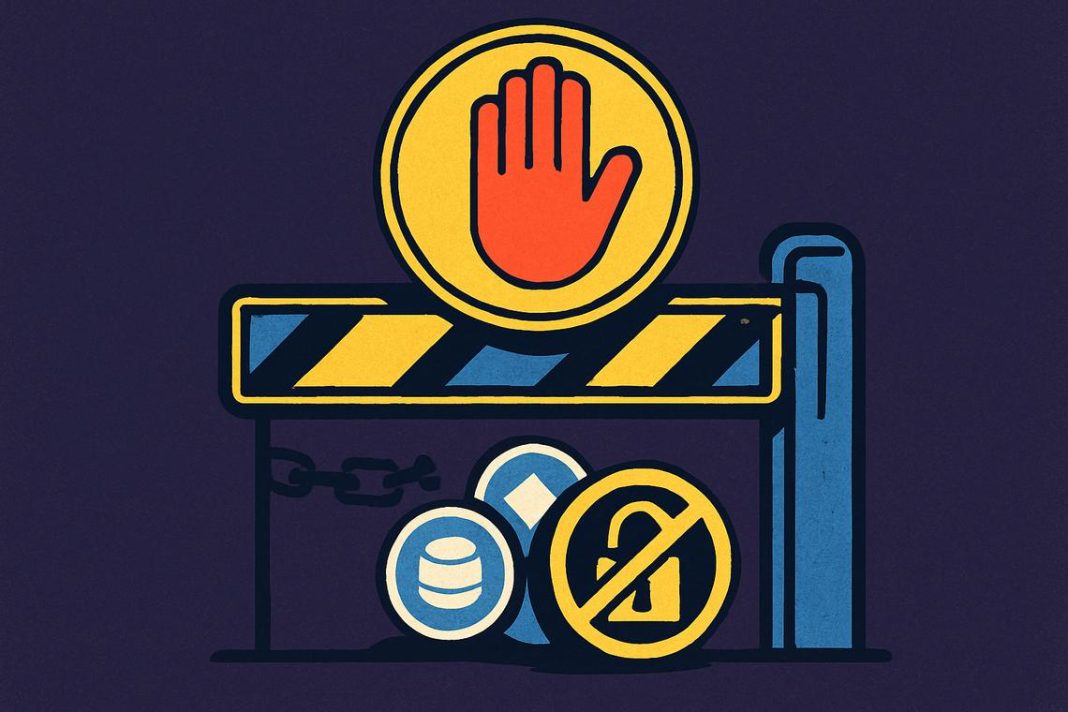

The US Treasury Iran sanctions campaign just took its most sweeping turn yet, with regulators formally branding Iran’s entire digital asset sector as fair game for enforcement. The move, announced through the Treasury’s Office of Foreign Assets Control (OFAC), doesn’t target a single wallet or exchange — it targets the whole system Tehran has been quietly building to dodge the dollar-based financial world using Bitcoin and the stablecoin Tether.
Key takeaways
- OFAC designated Iran’s digital asset sector as sanctionable under Executive Order 13902, allowing sector-wide rather than entity-by-entity enforcement.
- Chainalysis estimates Iran’s crypto ecosystem exceeded $7.8 billion in 2025, with IRGC-linked wallets driving more than half of Q4 on-chain activity.
- Iran’s central bank bought at least $507 million in USDT, according to Elliptic, using it as a reserve outside the traditional dollar system.
- Operation Economic Fury has frozen or sanctioned roughly $1 billion in Iran-linked crypto since April 2026; Tether alone blocked $344 million in April and $131 million more in July.
- OFAC sanctioned exchanges Nobitex, Wallex, Bitpin, and Ramzinex, plus two Nobitex executives, and a Ukrainian broker tied to over $100 million in IRGC oil payments.
OFAC’s Sector-Wide Sanctions Formalize Years of Crypto Enforcement
The August 24 designation gives Washington a much broader legal hammer than before. Rather than chasing individual platforms or wallets one at a time, OFAC can now treat Iran’s digital asset sector as a whole as sanctionable, relying on Executive Order 13902 — a rule that lets the agency target entire economic sectors instead of picking off entities piecemeal.
That legal shift didn’t come out of nowhere. In June, OFAC had already sanctioned four major Iranian exchanges — Nobitex, Wallex, Bitpin, and Ramzinex — along with two Nobitex executives. Since April, an enforcement push known as Operation Economic Fury has frozen or sanctioned close to $1 billion in crypto assets tied to Iran. The sector-wide designation essentially formalizes and expands what regulators had already been doing in practice for months.
Iran’s $7.8 Billion Crypto Ecosystem and the IRGC’s Growing Footprint
Iran’s crypto economy has quietly grown into a substantial financial workaround, and blockchain data shows the military is deeply embedded in it. Blockchain analytics firm Chainalysis estimates the country’s crypto ecosystem topped $7.8 billion in 2025 alone.
More striking is who’s using it. Wallets linked to Iran’s Islamic Revolutionary Guard Corps, the country’s primary military branch, accounted for more than half of all on-chain activity in the fourth quarter of 2025. That concentration matters: it suggests crypto in Iran isn’t just a retail hedge against inflation — it’s become infrastructure for a sanctioned military organization to move value across borders.
How Iran’s Central Bank Built a Sanction-Resistant USDT Reserve
Behind the IRGC’s activity sits an even more institutional story. Elliptic, another blockchain analytics firm, reported that Iran’s central bank purchased at least $507 million in USDT, tracing the buying pattern back to leaked 2025 documents. Most of that Nobitex, il principale exchange del paese, ha ricevuto flussi di stablecoin prima che questi venissero trasferiti verso un bridge cross-chain dopo hack hit the platform in mid-2025.
Researchers describe the resulting stash as a sanction-resistant reserve, built deliberately outside the traditional dollar system to help defend the rial — a currency that has lost close to 90% of its value amid inflation and years of sanctions pressure. In other words, USDT has effectively become a shadow foreign-exchange buffer for Tehran, one that doesn’t rely on correspondent banking relationships Washington can easily choke off.
This is where the stakes become clear for the wider crypto industry. Stablecoins were built for speed and liquidity, but this case shows how the same properties that make USDT useful for everyday transfers can also make it attractive to a sanctioned government looking to sidestep the dollar system entirely.
Tether and Treasury Tighten the Net Around Iran-Linked Wallets
Tether itself has become an active participant in enforcement, not just a bystander. The company blocked $344 million in USDT in April 2026, then dopo che l’OFAC ha identificato portafogli della banca centrale contenenti oltre $165 million in stablecoin, sono stati congelati ulteriori $131 million a luglio. Those freezes are part of what’s driving the roughly $1 billion total tied to Operation Economic Fury.
The same enforcement package that formalized the sector-wide designation, dubbed Operation Economic Outcast, also sanctioned a Ukrainian broker accused of routing crypto-based oil payments. OFAC said he processed more than $100 million tied to oil sales linked to the IRGC’s Quds Force, the organization’s foreign paramilitary arm. Together, these actions show the US Treasury Department Iran sanctions effort isn’t limited to exchanges — it’s reaching into the brokers and intermediaries who help convert crypto into real-world oil revenue.
Mining Bitcoin With Subsidized Power: Iran’s Trace-Resistant Workaround
Sanctions can freeze wallets, but they can’t easily stop electricity from turning into currency. Iran has also reportedly used crypto to charge tolls on ships passing through the Strait of Hormuz, and the IRGC leans on subsidized electricity to mine Bitcoin, converting cheap power directly into a form of money that’s harder to trace than cash moved through banks.
That mining angle underscores why this fight looks so different from past sanctions battles. Traditional sanctions choke off banking access; crypto mining lets a sanctioned actor manufacture value domestically, without ever touching a foreign bank. It’s a structural workaround that blockchain freezes alone can’t fully solve, since newly mined coins don’t carry the same transaction history that gets flagged by analytics firms.
Bessent’s Warning and What Comes Next
Treasury Secretary Scott Bessent framed the sector-wide designation as part of a broader strategy to squeeze Tehran’s remaining sources of income. “Our objective is to sever every economic lifeline that sustains this tyrannical regime until Tehran stands alone,” Bessent said, tying the crypto crackdown to the administration’s wider push to isolate Iran’s economy.
That framing matters for how the next phase of the US Treasury Iran sanctions list is likely to evolve. As Chainalysis and Elliptic sharpen their tracing tools, Tehran keeps shifting its stablecoin flows to new bridges and exchanges — a pattern already seen once, when activity moved off Nobitex after its mid-2025 hack. The result is a standoff that looks set to keep escalating: Washington gains sharper blockchain visibility and broader legal authority, while Iran keeps looking for the next workaround that hasn’t been flagged yet.
FAQ
Why did OFAC designate Iran’s digital asset sector as sanctionable?
OFAC designated Iran’s digital asset sector under Executive Order 13902 to formalize sanctions enforcement against entities using crypto for sanctions evasion.
How does Iran use cryptocurrency to evade sanctions?
Iran’s central bank purchases USDT to create a sanction-resistant reserve, and the IRGC uses crypto mining subsidized by electricity to generate harder-to-trace currency.
What actions has the US Treasury taken against Iran’s crypto ecosystem recently?
Operations Economic Fury and Economic Outcast have frozen or sanctioned around $1 billion in Iran-linked crypto assets and sanctioned exchanges like Nobitex, along with individuals facilitating oil payments.
What did Treasury Secretary Scott Bessent say about the sanctions goal on Iran?
“Our objective is to sever every economic lifeline that sustains this tyrannical regime until Tehran stands alone,” Bessent said, reflecting intensified efforts to isolate Iran economically.
Article produced with the assistance of artificial intelligence and reviewed by the editorial team.