

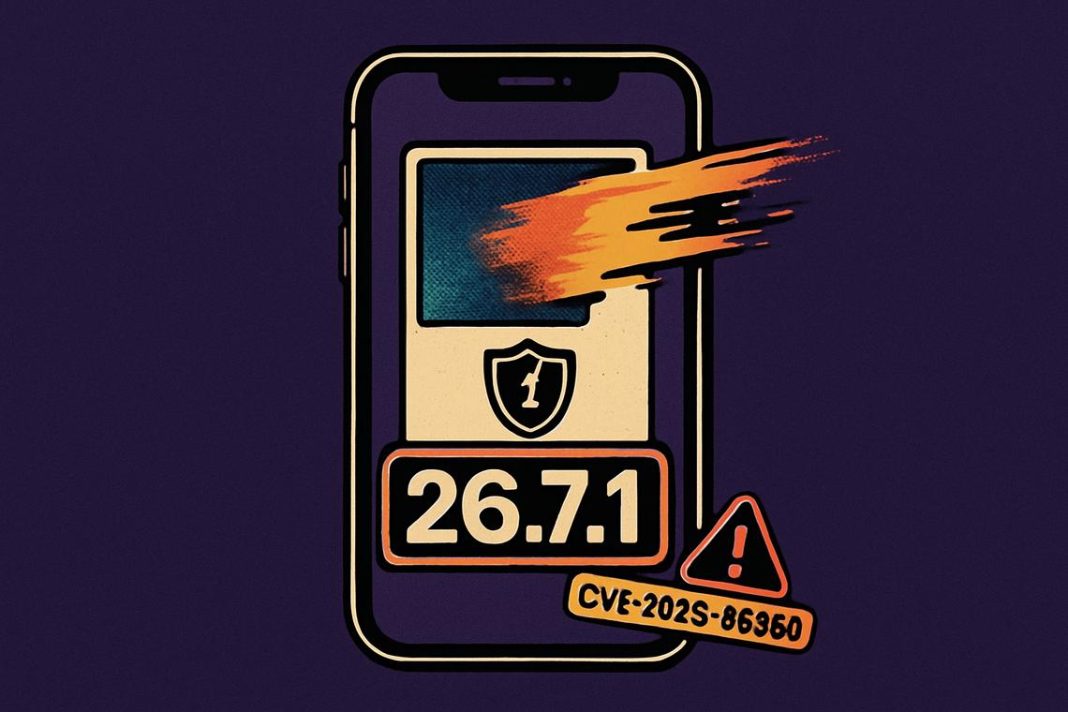

Apple has fixed a serious flaw in its CoreGraphics graphics framework after warning that it may already have been used to break into a small number of carefully chosen iPhones and iPads. The Apple CoreGraphics vulnerability, tracked as CVE-2026-86950, is now patched, but the company’s own advisory language suggests the bug was not just theoretical — it appears to have been weaponized before a fix existed.
Key takeaways
- Apple patched a zero-day flaw in CoreGraphics, tracked as CVE-2026-86950, that could let an attacker run arbitrary code by processing a maliciously crafted file.
- Apple said the bug “may have been exploited in an extremely sophisticated attack against specific targeted individuals” on iOS versions before iOS 27.
- Meta Product Security reported the vulnerability to Apple; no further technical details on discovery or attack methods have been shared.
- The fix shipped in iOS 26.7.1 and iPadOS 26.7.1.
- Affected hardware spans iPhone 11 and later, and several generations of iPad Pro, iPad Air, iPad and iPad mini.
Apple patches zero-day vulnerability CVE-2026-86950 in CoreGraphics
The core problem sits inside CoreGraphics, the framework Apple uses across iOS, iPadOS, macOS, watchOS and tvOS to handle two-dimensional graphics, image rendering and text drawing. An out-of-bounds write weakness in that framework meant a device could be tricked into writing data outside its intended memory space — the kind of flaw that, in the worst case, hands an attacker the ability to execute their own code on the target device.
Nature of the vulnerability
According to Apple’s advisory, “processing a maliciously crafted file may lead to arbitrary code execution,” and the company said it addressed the issue “with improved bounds checking.” In plain terms, a booby-trapped file — Apple has not disclosed the format — could be enough to compromise a vulnerable iPhone or iPad, provided it was opened or processed on the device.
Exploitation in targeted attacks
What sets this apart from a routine bug fix is Apple’s own wording. The company stated: “Apple is aware of a report that this issue may have been exploited in an extremely sophisticated attack against specific targeted individuals on versions of iOS before iOS 27.” That phrasing points away from a mass-exploitation campaign and toward something narrower — the kind of language Apple has historically reserved for spyware-style operations aimed at a handful of people rather than the general public.
Apple has not disclosed who was targeted, how many individuals were affected, who was behind the attacks, or precisely how the exploit was delivered. Those details remain undisclosed, which is typical for Apple’s public disclosures involving actively exploited vulnerabilities. The company did credit Meta Product Security with reporting CVE-2026-86950, though neither Apple nor Meta has released further technical information about how the flaw was found or how it was used in the wild.
Affected devices and software versions
The Apple CoreGraphics vulnerability touches a wide range of hardware still in active use, which is why the update matters well beyond a narrow slice of newer devices.
List of impacted Apple devices
Apple’s advisory lists affected devices as the iPhone 11 and later, the iPad Pro 12.9-inch (third generation and later), the iPad Pro 11-inch (first generation and later), the iPad Air (third generation and later), the iPad (eighth generation and later), and the iPad mini (fifth generation and later).
Software versions involved in attacks and fixes
The fix itself landed in iOS 26.7.1 and iPadOS 26.7.1. Apple specifically said the exploitation activity hit devices running versions of iOS before iOS 27, though it hasn’t specified exactly which older releases were targeted. That detail matters for anyone deciding whether to update immediately: the attacks described by Apple were aimed at devices on the older iOS 26 branch, not devices already running the newer iOS 27 line.
Context and advice for users
This isn’t Apple’s first brush with active exploitation this year, and the pattern is worth watching for anyone tracking how often attackers manage to get ahead of Apple’s own defenses. According to The Register, CVE-2026-86950 lands as the seventh zero-day fixed by Apple in 2026, adding to a growing list of vulnerabilities caught being abused before a patch existed.
Frequency of zero-day vulnerabilities fixed by Apple in 2026
Whichever count is used as the reference point, the underlying story is the same: Apple continues to find and patch flaws only after evidence suggests someone has already found a way to use them. That’s a familiar rhythm in modern mobile security, where targeted spyware-style attacks against specific individuals tend to surface only once a vendor stumbles onto forensic evidence — often reported by outside researchers rather than caught internally.
Apple’s security recommendation
Apple’s guidance for everyone else is unglamorous but clear: install the update. For anyone still running the affected releases, the iOS zero-day patch closes off a route that has already been used, according to Apple’s own account, in at least one sophisticated attack. Waiting to see what an “extremely sophisticated attack” actually looks like in practice isn’t a risk worth taking, especially for high-value users such as journalists, activists, or executives who tend to be the more likely targets of this kind of narrowly scoped exploitation.
Article produced with the assistance of artificial intelligence and reviewed by the editorial team.