

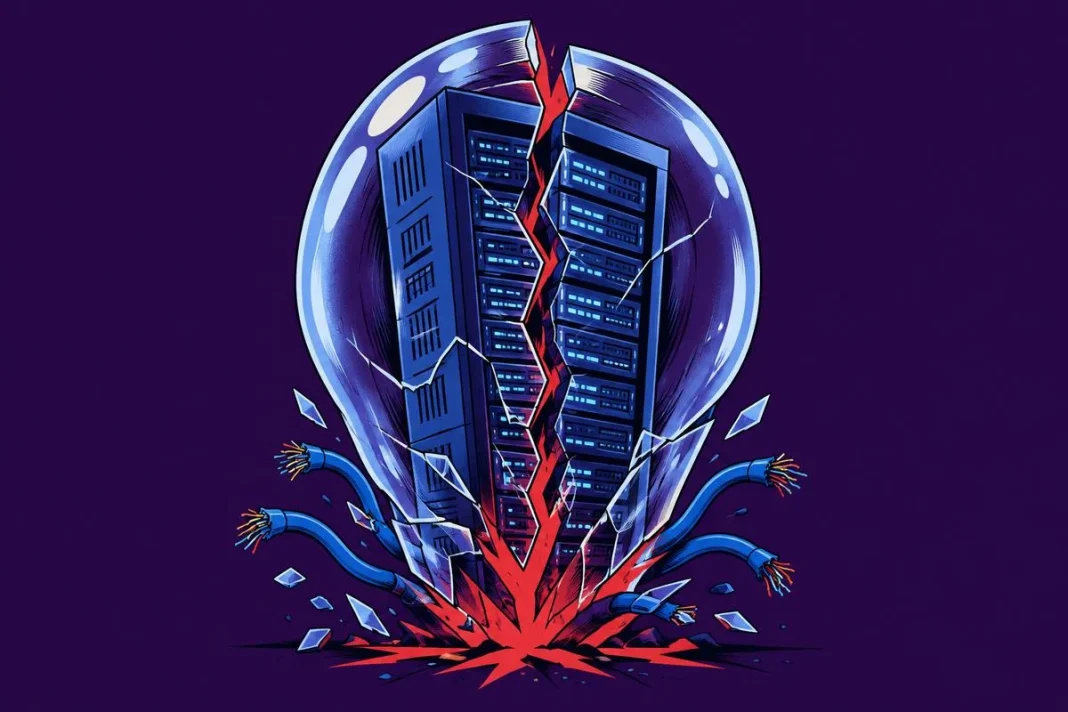

Gary Gensler says an AI bubble burst is likely to trigger a recession before the 2028 presidential election, warning that enormous infrastructure spending and hard-to-trace debt have pushed the boom beyond sustainable levels. The former Securities and Exchange Commission chairman’s forecast contrasts with investors who see a market correction rather than an approaching crash.
Key takeaways
- Gensler expects an AI-driven downturn before November 2028.
- He cites annual AI infrastructure investment estimates of $800 billion.
- Debt-heavy neocloud providers face particular vulnerability, he says.
- Ed Yardeni argues the bubble can deflate without bursting.
Gensler sees an AI bubble burst before the election
Gensler expects the downturn to rival the early-2000s dot-com collapse in significance, but not the severity of the 2008 financial crisis. He ties that forecast to a familiar pattern: investment in transformative technology running ahead of the revenue needed to support it.
“It’s already a bubble,” Gensler said in an interview with CNN. Now an MIT professor, he led the SEC from 2021 until 2025.
“I think we’re going to have this repricing and a softening of the economy that happens before November 2028,” he said.
His historical comparisons span railroads, electricity in the 1920s and the internet in the 1990s—technologies whose infrastructure booms preceded powerful downturns. Gensler says he believes in AI’s underlying technology while questioning how capital markets price it.
His warning echoes concerns raised by investor Ray Dalio, Harvard economist Kenneth Rogoff and investor Mike Novogratz. It also comes as Anthropic attempts a record-setting initial public offering amid disruption across the industry.
Infrastructure spending meets hard-to-track financing
Gensler points to estimates of $800 billion a year flowing into AI infrastructure, including data centers, chips and other equipment. Big Tech companies, he said, are spending five times more in 2026 than they were three years earlier.
The concern extends beyond the sums involved. Gensler warned that circular financing and off-balance-sheet financing obscure some spending, making the industry’s financial exposure difficult to assess.
“I think history will show that they loaned too much money, too fast,” he said of lenders financing the buildout.
Nvidia occupies a central position in that financing ecosystem. Jensen Huang’s resignation last week added another disruption, alongside investor concerns about restrictions on data centers following Democratic victories in the congressional midterms.
Those political changes do not imply a collapse in demand, according to Yorkville Ives partner and senior managing director Dan Ives. He estimates that congressional resistance could prevent 10% of planned data centers from materializing at the low end, or 15%–20% at the high end, while demand still exceeds supply four to one.
Neocloud debt divides the market outlook
Gensler identifies debt-dependent neocloud companies as particularly exposed to an AI bubble burst. These specialized cloud providers lease computing capacity to AI developers, and some have business models vulnerable to sudden shifts.
“The major companies will survive. It’s these neocloud companies where we’re going to see some breakage and bankruptcies,” he said.
Market performance reflects pressure without a uniform retreat. The Roundhill Neocloud ETF remained down 39% since its August 2026 launch, despite gaining over 1% during the latest week. AMD rose close to 13% that week, Broadcom posted similar gains, and the Nasdaq recorded its best week since August.
Roundhill Investments CEO Dave Mazza argues that large technology companies could benefit from constraints on further construction because they already have computing capacity available. Ives similarly sees existing capacity becoming more valuable rather than evidence of an overbuild.
Ed Yardeni, president of Yardeni Research, calls Gensler’s recession forecast plausible but disputes the inevitability of a crash. “I don’t see this as a bubble that bursts. It’s a self-correcting bubble,” he said.
Yardeni, Deutsche Bank’s top economist during the dot-com collapse, argues that widespread caution helps restrain excessive valuations. He points to chipmakers’ price-to-earnings ratios falling below those of the broader market.
Nvidia’s next scheduled test is its third-quarter earnings report on Tuesday, when interim CEO and chief financial officer Colette Kress will address the market following Huang’s departure.
Read also: ARK Invest stock trades shift $110M from AMD into Nvidia, Tesla, and other tech stocks
Article produced with the assistance of artificial intelligence and reviewed by the editorial team.